
Hi everyone - happy 2026! It’s been a while since I posted something new and I want to get back into the habit of writing again :). Hopefully will try to get at least something out once a month and as always, if anything resonates or if you have any feedback, please let me know.
The current tech debate de-jour is what is defensible at the app layer and I wanted to put some pen to paper on how I think about it!
Almost every founder I talk to right now is building AI agents or buying them. The pitch deck is always something along the lines of: Better benchmarks! More tool integrations! Bigger context window!
In a world where competing on raw compute is a game only a few companies can win, what actually matters?
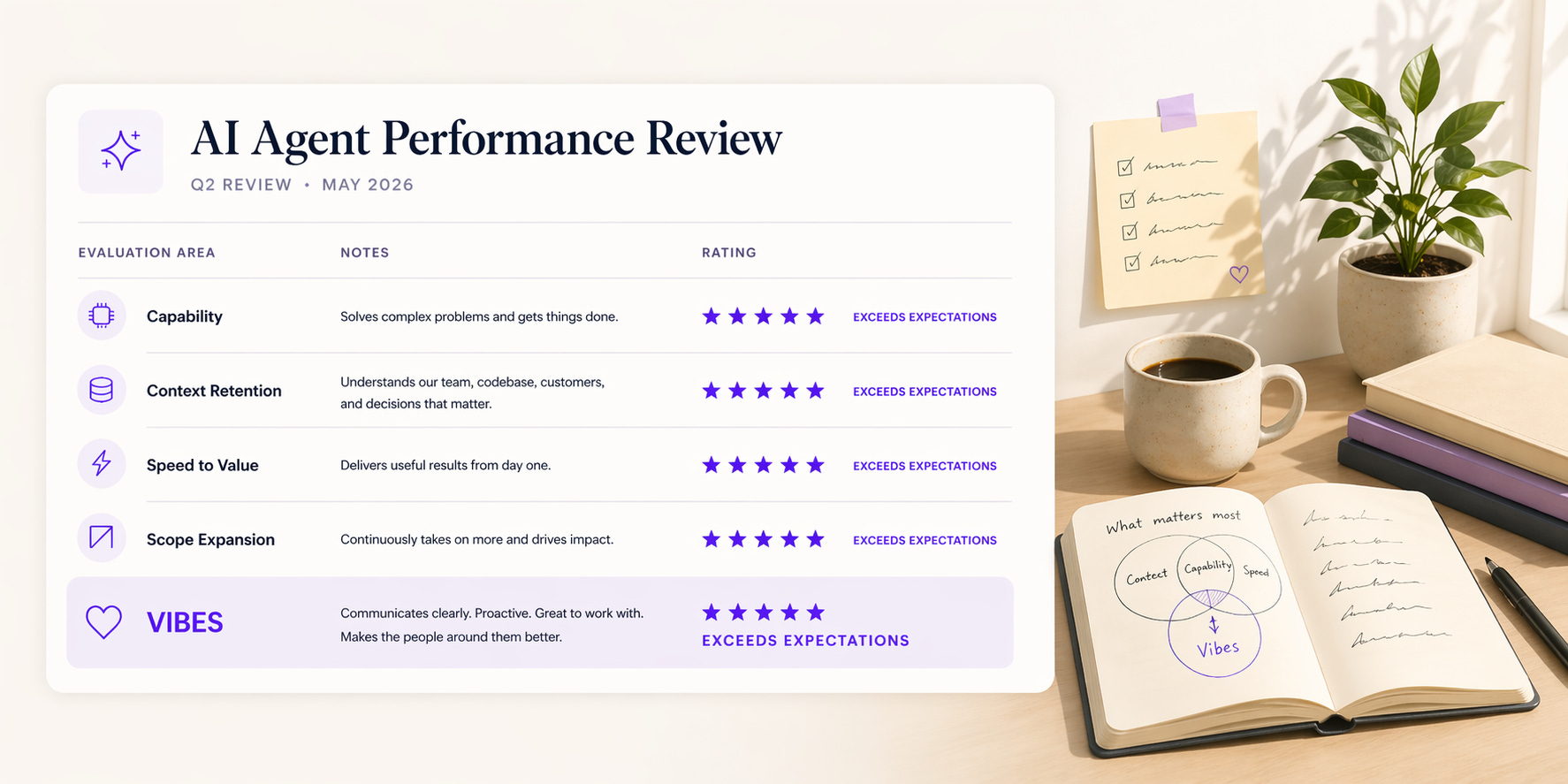
I think the defensibility of AI agents has almost nothing to do with raw capability / intelligence, and everything to do with something most of us deeply understand: what makes a great employee impossible to replace.
Hiring is the original hard problem
Ask any founder or executive on what’s the hardest part of scaling a company post product market fit. It’s hiring great people.
What makes someone truly great though? It’s not just that they’re smart. The employees that are true barrels for the company:
Ramp absurdly fast. The best hires are able to get up to speed quickly and start getting to work immediately.
Grow faster than their role. You hired them for X, and six months later they’ve absorbed Y and Z and are constantly making you rethinking their side of the organization. The best employees proactively expand the surface area of what they can do.
Compound their domain expertise. They don’t just know the job, they know your version of the job. They know why you made that weird architectural decision in 2021, why that partner integration is duct-taped together, why you don’t sell to that segment, why the integration engine is called “The Kraken”. This context takes months / years to build, and it isn’t just available from integrating into tools/CRMs/ERPs. It requires being deeply embedded into the organization and interaction time with teammates across the company.
And then there’s*vibes.*
They communicate the way your team communicates. They have the right instincts for when to escalate and when to just handle it. They proactively make the people around them better. You actually genuinely enjoy working with them and so does everyone else!
The best moat for AI agents is simply being the best employee
We’re currently in “job posting” era for AI agents, where everyone is listing the same features + requirements and wondering why all the candidates look the same.
But the best agents that companies are adopt and never switch away from win on the same dimensions that make great employees sticky:
Context accumulation as a moat. The best agents learn your codebase, your customers, your internal language, your preferences, your past decisions. Every interaction makes them harder to replace, not because of switching costs in the traditional sense, but because they’ve built up the equivalent of institutional knowledge. Aka through accumulated interactions with your team, they know why your team calls the integration system “The Kraken” and why only Shawn can touch that code.
Speed to value. No one really cares about benchmarks, it’s the equivalent of comparing two resumes that both went to Harvard and one had a 3.9 GPA and the other a 3.8 GPA. Claude Code started to rapidly become the new developer default because you could drop it into a real codebase and it started doing useful things immediately. No config hell, no 30-page setup docs, no back and forth correcting it’s code - it just worked.
Expanding scope. The best agents today started as a coding assistant and ended up doing code review, writing tests, drafting docs, refactoring entire modules, debugging production issues. It’s the same arc as your best IC who came in as a frontend engineer and is now your tech lead. The best AI agents aren’t stagnant / doing the same job over and over, but rapidly expanding out their remit and the jobs they can do.
And then there’s ~vibes~
Your agent’s vibe should be a key product decision
Why did developers start gravitating toward Claude? It wasn’t just that it was S tier at code (although that definitely was a key factor). It also felt like a teammate you’d actually want to pair with. Thoughtful but not sycophantic. Direct but not robotic. Anthropic made a deliberate product decision about Claude’s vibe, and it resonated. Developers don’t just use Claude, they prefer it, the same way you prefer certain colleagues! That kind of preference is incredibly hard to compete away with benchmarks alone (although with some of the recent supposed degradation in code quality with Opus, vibes aren’t a substitute for actual performance.)
Now let’s extend this to vertical agents! If you’re building an AI agent for legal work, the vibe should probably feel precise, measured, and careful. An agent for sales should feel energetic, persistent, and commercially sharp. An agent for a creative team should feel curious and generative rather than prescriptive.
What this means for founders building AI agents
If you’re building AI agents, start thinking about what kind of employee you’re creating.
Be deliberate about your agent’s vibe and match the culture of your customer. This isn’t “pick a funny name and add some emojis.” It’s a fundamental product decision about tone, communication style, when your agent should be proactive vs. reactive, how it handles uncertainty, how it pushes back. A developer tool agent and an enterprise sales agent shouldn’t feel remotely the same, even if they’re running on identical models under the hood.
Deliver a win on day 1. The best hires earn trust immediately by shipping something real, not by sitting through onboarding decks. Your agent should do the same. What’s the equivalent of pushing a great PR on the first day for your industry? Find that moment and make it happen before the user has time to second-guess their decision or give something else a try.
Build for context accumulation, not just task execution. The agents that customers want to keep will be the ones that remember, learn, and get better with every interaction. Your agent should be harder to leave after six months than after six minutes.
So, are you building your agents to be irreplaceable?
Everyone in AI is trying to build the smartest agent. But the companies that win will build agents that their customers would never want to fire.
If you’re actively building agents as the best version of an employee or have other thoughts on the above, hit me up please at charley@pathlight.vc :)